
Many of us have been so caught up in the exciting rush of tech hype, that perhaps we’ve neglected to pause and ask some basic questions. Like, why do we need self-driving cars? Is it for the same reason we need self-brushing teeth? Maybe. The arguments are, broadly speaking, that we need them because humans are too stupid to drive cars themselves.

As a card-carrying member of the human race, I would take offence at that, except that I’m part of the subspecies South African. So I’ve seen in all too vivid closeup how extraordinarily bad some drivers can be. But is the answer really to let AI drive for us, and thereby put millions of commercial drivers out of work as the taxi industries and long-haul trucking industries become fully dehumanised?
In fact, are we being suckered in general by the lofty ambitions of tech companies, who pursue growth and change at all costs, and who are judged — or choose to be judged — by their inexorable progress towards some always unattainable goal?
Take Apple, for example, which in August 2018 became the first company (depending how you measure this) to hit a $1-trillion market valuation. When the company launched its iPhone 17 series on September 20 2025, it triggered one of Apple’s largest market value declines in recent years.
Apple’s market capitalisation stood near $3.52-trillion before the event. A 3.2% decline wiped out about $112.6bn, roughly the size of Nike’s entire market value, according to Gulf News. The company’s shares dropped 3.2% in two days after the unveiling.
Why, you ask? Well, one of the main reasons was that the launch featured “incremental updates, not breakthroughs: Wall Street had been looking for a disruptive upgrade cycle. Instead, the iPhone 17 lineup delivered slimmer designs and modest hardware tweaks.”
See what I mean about always having to chase the next big thing? “The market”, that shibboleth so beloved of readers of financial magazines, punished a company for just producing an excellent product. It has to be new, bigger (well, smaller in the case of Apple), better.
Often the rush to market, the cycle of needing to produce the next new thing, can bite the companies involved. And, in some cases, the new technology can also savage bystanders.
Tesla and Elon Musk, who among other things has promised to put a self-driving dildo on Mars by 2026 (or something like that, I might have the details confused), is being sued by shareholders in a proposed class action alleging securities fraud relating to claims about the safety and prospects of Tesla’s self-driving Robotaxi vehicles.
The lawsuit was filed after Tesla’s public test of its robotaxis in Austin, Texas, in late June 2025. The results suggest that the robotaxis have a lot in common with South African taxi drivers, as the test revealed several safety issues such as speeding, sudden braking, driving over curbs, entering wrong lanes and dropping off passengers in unsafe locations. These incidents led to a 6.1% drop in Tesla’s share price, erasing about $68bn in market value.
Reuters said: “Musk and his electric vehicle maker were accused of repeatedly overstating the effectiveness of and prospects for their autonomous driving technology, inflating Tesla’s financial prospects and stock price. Shareholders said this included Musk’s assurance on an April 22 conference call that Tesla was ‘laser-focused on bringing robotaxi to Austin in June,’ and Tesla’s claim the same day that its approach to autonomous driving would deliver ‘scalable and safe deployment across diverse geographies and use cases’.”
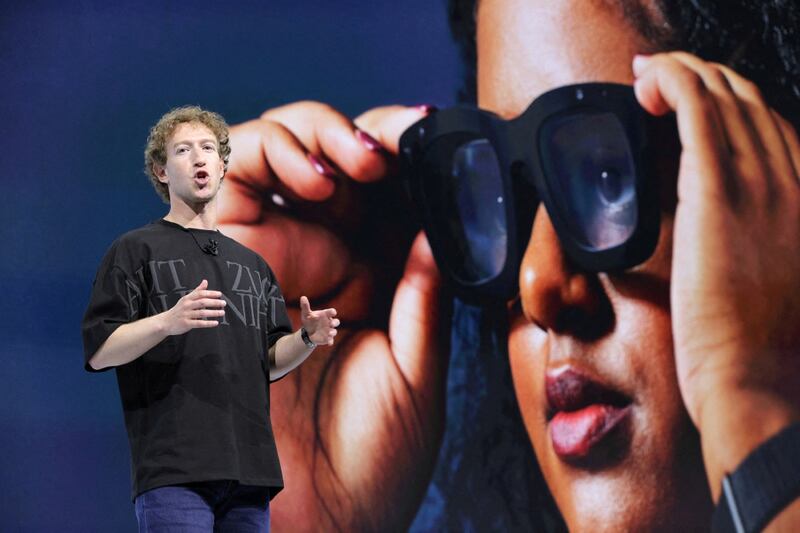
Big promises, though in some cases, as with AI hype, promises is just a synonym for lies. Speaking of big promises, Meta’s launch of its new smart glasses (the lineup includes the updated Ray-Ban Meta (Gen 2) for $379, the sports-focused Oakley Meta Vanguard for $499, and the flagship Ray-Ban Display with built-in screen for $799) was a gift to devotees of schadenfreude everywhere.
According to Mashable, “the glasses failed spectacularly during live demos at Meta Connect, including one where Zuck himself was left scrambling to fill the awkward silence as a planned phone call never materialised”. The first “awkward glitch” of the night, as related by Business Insider, was when “Zuckerberg connected food content creator Jack Mancuso to the big screen for a live demo on how the newly upgraded Ray-Ban Meta glasses could help Mancuso cook.
“Mancuso asked the glasses with voice control to show him how to mix a ‘Korean-inspired steak sauce’ for his steak sandwich. Instead of starting with the basic steps, the AI responded that he should use soy sauce and sesame oil. Mancuso asked what he should do first multiple times, but the AI ignored his inquiries and moved on with its instructions.”
Well, clearly finding the solution to world hunger is going to be more difficult than our tech overlords claim. Later, Meta’s chief technology officer explained what the problem was.
“When Mancuso said ‘Hey Meta, start Live AI,’ it inadvertently activated every single Ray-Ban Meta Live AI system in the building, creating an overwhelming flood of simultaneous requests.” In other words, the geniuses at Meta created their own distributed denial-of-service attack.
Such is the pursuit of the next big thing, that people are willing to waste billions of dollars on it. And everyone seems pretty sure that AI superintelligence is the next big thing, which is probably a good time to remember that Zuckerberg was just as sure in 2021 that the metaverse was the next big thing.
The Meta CEO is quoted on Yahoo Finance as saying: “If we end up misspending a couple hundred billion dollars, that’s going to be very unfortunate obviously. But I would say the risk is higher on the other side. If you build too slowly, and superintelligence is possible in three years but you built it out assuming it would be there in five years, then you’re out of position on what I think is going to be the most important technology that enables the most new products and innovation and value creation in history.”
In the same interview, Zuckerberg drew parallels between potential AI infrastructure overbuilding and historical bubbles such as the railroad boom and dot-com crash. “Based on past infrastructure build-outs and how they led to bubbles, I do think there’s definitely a possibility that something like that would happen here,” he said.
During the dot-com bubble, investors poured money into tech startups with unrealistic expectations, driven by hype and a frenzy for new internet-based companies. When the results fell short, in the early 2000s the stocks involved lost more than $5-trillion in total market cap.
I’m all for the shiny and new in general, but I can’t help feeling that pursuing the new merely for the sake of market forces is a dangerous game
I’m all for the shiny and new in general, but I can’t help feeling that pursuing the new merely for the sake of market forces is a dangerous game. We all have fond memories of the bitcoin bros, those crypto-messiahs who spread the word of the blockchain. One of the founders of the public blockchain platform Solana recently issued a warning to the bitcoin community, predicting a 50% chance of a quantum computing breakthrough by 2030 that could threaten the cryptocurrency’s underlying security. If quantum computing does destroy bitcoin’s cryptographic security, the ecosystem would face an existential crisis, which could potentially result in a huge loss of funds, trust and market stability.
It’s all just a cascade of cause and unforeseen effect. The real issue, though, is when the consumers formerly known as citizens are caught up in the helter-skelter pursuit of the new in the service of profit.
Is it possible to have innovation that is driven by civic good rather than the techbros’ need to build a better bunker for the post-apocalyptic world they appear to be driving us towards? Or does it always have to be in the service of shareholders? I’m happy to let Zuck (the diminutive that tech journalists use to create the illusion that he is a chummy, knowable entity) waste his billions of dollars. I’m less happy to let him waste my life.





Would you like to comment on this article?
Sign up (it's quick and free) or sign in now.
Please read our Comment Policy before commenting.